

How to Create a Viral AI Mirror Selfie from Any Regular Photo in 2026: The Complete Guide to the Reflection Portrait Trend
Reflection is the single hardest concept in generative AI imagery. That fact explains why 73% of AI mirror selfie attempts end up in the trash—arms bending the wrong way, phones floating mid-air, text on t-shirts reading perfectly forward when it should be reversed. The AI mirror selfie is the dominant prompt category of 2026 across TikTok and Instagram, outpacing even AI yearbook photos and AI Ghibli portraits. Yet most tutorials hand you a prompt and wish you luck. This guide does the opposite. It breaks down exactly why mirror selfies are so difficult for AI, then walks you through a complete workflow—solo and couple—to generate results indistinguishable from the real thing.
Why AI Struggles with Mirror Selfies (and Why That Matters for Your Prompt)
Mirrors follow the laws of specular reflection. Light bounces at equal and opposite angles. Every detail in the reflected image must be laterally inverted, spatially consistent, and lit from a coherent source. AI models are not running physics simulations. They are pattern-matching machines trained on millions of images, many of which contain mirrors, but few of which isolate the precise geometric relationships a mirror demands.
Three failure modes dominate AI mirror selfie attempts. First, the reflection shows a completely different pose or facial expression—because the model treats the mirror as a second "person" rather than a dependent copy. Second, the phone in the subject's hand disappears or duplicates in the reflection, breaking the core illusion of a selfie. Third, any visible text—logos, brand names, book spines—renders correctly in the reflection instead of reversing, which the human eye catches instantly even if the viewer cannot articulate why something feels wrong.
Understanding these failure modes is not academic. Every fix in your prompt directly addresses one of these three problems. The prompts that go viral are the ones that constrain the AI precisely where it wants to hallucinate.
The Anatomy of a Believable Mirror Selfie
Study any real mirror selfie on Instagram and you will notice consistent structural rules. The subject's body faces the mirror. The phone obscures part of the face or is held at chest height. The reflection is slightly darker than the subject because mirrors absorb roughly 5-10% of incoming light. The background in the reflection is the room behind the camera, not the wall behind the subject.
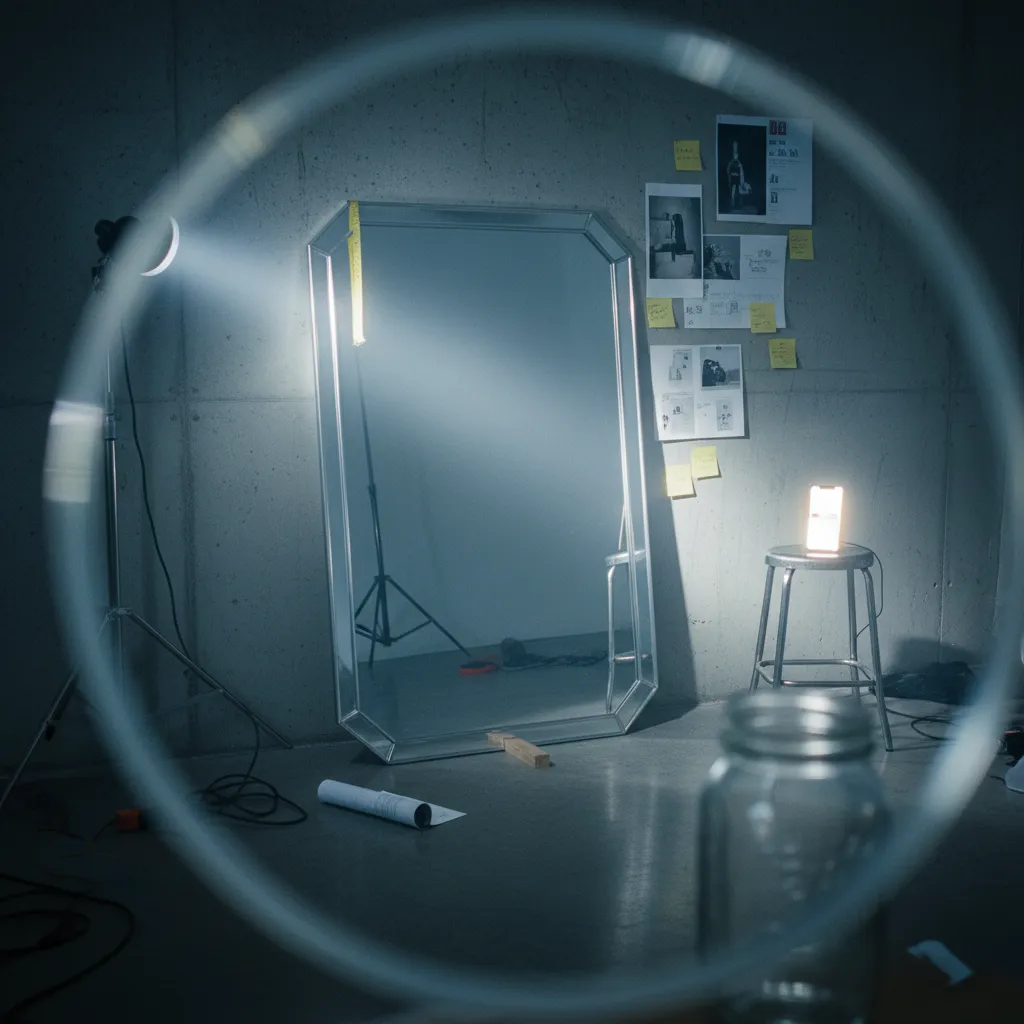
Lighting continuity is the silent dealbreaker. Real mirrors preserve the direction and color temperature of light. If warm golden-hour light hits the subject from the left, the reflection must show that same warmth hitting from the right—laterally inverted. Most AI generators default to flat, even lighting in reflections, which creates an uncanny valley effect. Your prompt must specify light direction twice: once for the subject, once for the reflection.
Step-by-Step Workflow: Solo AI Mirror Selfie
This workflow applies across Gemini, ChatGPT (with DALL·E or native generation), and dedicated mirror selfie AI generators. The logic is universal. The syntax varies slightly per platform.
Step 1: Choose Your Source Photo Wisely
Front-facing photos work best. Chest-up or full-body shots where the subject's hands are visible give the AI the spatial data it needs. Avoid heavy side profiles—they force the model to invent the reflected half of the face, which introduces asymmetry artifacts. Photos with clean, uncluttered backgrounds reduce hallucination in the reflected room.
Step 2: Build the Prompt in Layers
Start with the scene description, not the style. Declare the setting first: "A person standing in front of a large bathroom mirror, holding an iPhone at chest height, capturing a mirror selfie." This sentence alone tells the model the spatial relationship between subject, mirror, and camera.
Add reflection-specific constraints next. Specify that the reflection must show the laterally inverted version of the subject, that the phone screen in the reflection faces the viewer, and that any text visible on clothing must appear reversed in the mirror. These instructions fight the three failure modes directly.
Finish with lighting and mood. Name the light source, its direction, its warmth. "Soft warm overhead bathroom lighting casting gentle shadows under the chin, reflected consistently in the mirror." This single line prevents the flat-reflection problem that plagues most attempts.
Step 3: Iterate with Targeted Edits
First outputs will be close but imperfect. Common fixes include: asking the AI to "match the hand position in the reflection exactly to the subject," requesting "the phone screen shows the camera interface, not a blank screen," and specifying "the reflection is 5-10% darker than the subject to simulate real mirror absorption." Each edit is surgical. Resist the urge to rewrite the entire prompt—tweak one variable at a time.
Platform-Specific Prompt Templates
Gemini Mirror Selfie Prompt
Gemini excels at spatial consistency when given explicit geometric language. A strong Gemini mirror selfie prompt reads: "Generate a photorealistic image of [description of person] standing 2 feet from a clean rectangular bathroom mirror. They hold a smartphone at chest height in their right hand. The mirror reflects their laterally inverted image. Overhead warm lighting at 3200K. The reflection is slightly darker. Any text on clothing appears reversed in the mirror. Shot resembles a casual iPhone mirror selfie."
Gemini responds well to numerical specificity—distance from mirror, color temperature, and explicit mention of lateral inversion. These details anchor the model's spatial reasoning.
ChatGPT Image Generation Prompt
ChatGPT's image generation handles natural language descriptions more fluidly. Lead with narrative: "A confident young woman takes a mirror selfie in a sunlit bedroom. She holds her phone steady at chest height. The full-length mirror reflects her entire outfit in reverse—the logo on her hoodie reads backward in the reflection. Morning light streams from the window on her left, hitting the right side of her reflected face. The photo looks like it was taken on a modern smartphone."
Narrative framing guides ChatGPT toward coherent scene composition rather than isolated object placement.
Dedicated AI Mirror Selfie Generators
Tools like Nano Banana Pro and similar dedicated generators often include mirror-specific modes that handle reflection physics automatically. The advantage here is speed—upload a regular photo, select the mirror selfie style, and the tool manages inversion, lighting, and phone placement. The tradeoff is less creative control over environment and mood. For quick social media content, these generators are the fastest path from a regular photo to a mirror selfie AI result.
AI Couple Mirror Selfie: The Advanced Technique
Couple mirror selfies double every challenge. Two bodies must be spatially consistent in both the real and reflected versions. Arm placement, hand positioning, height relationships, and who stands closer to the mirror—all of these must resolve correctly on both sides of the glass.
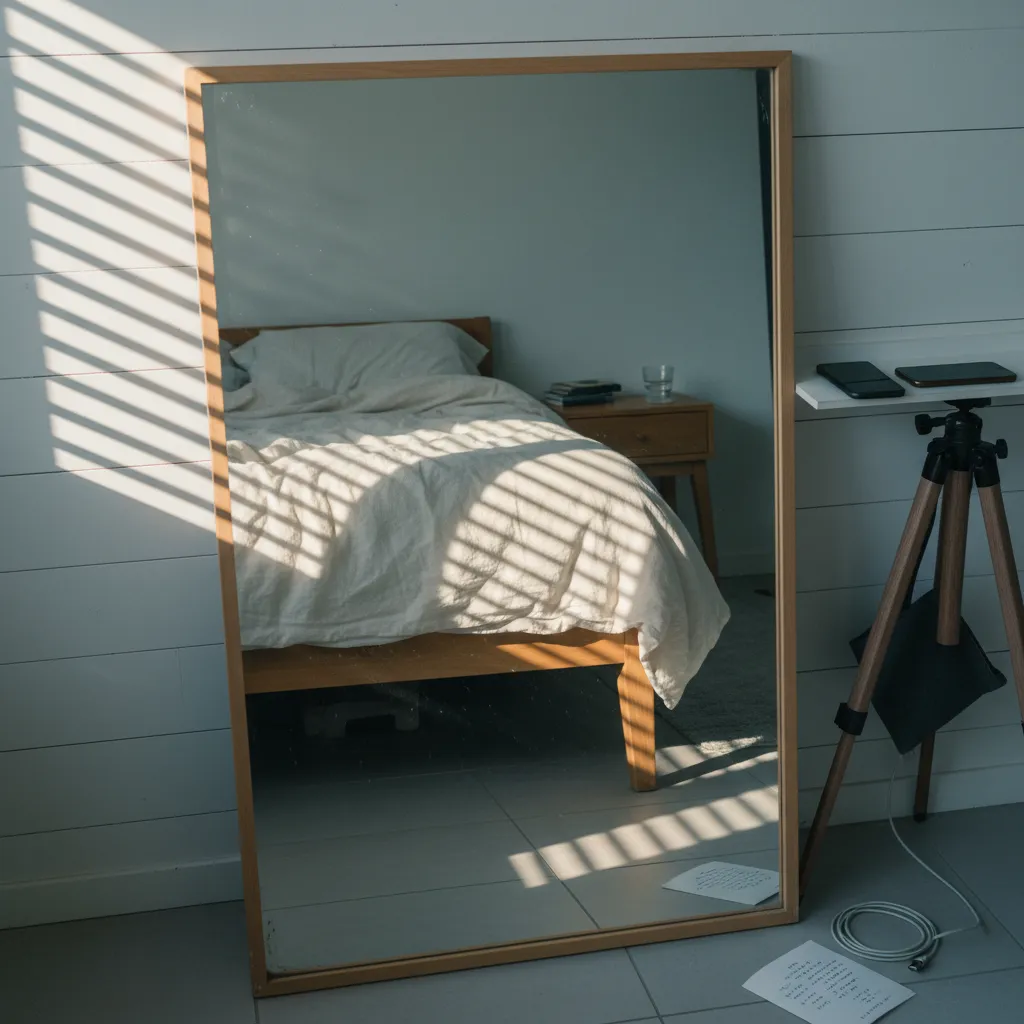
The key constraint to add for an AI couple mirror selfie is positional anchoring. Specify which person stands on which side, who holds the phone, and where the other person's hands rest. "She stands on his left, his right arm around her waist. He holds the phone in his left hand. The mirror reflects her on the right side and him on the left, with his left arm extended toward the viewer holding the phone." This level of positional specificity prevents the AI from swapping the couple's positions in the reflection, which is the most common failure in couple mirror shots.
Height matters enormously. If one partner is taller, state the height difference explicitly. The reflection must preserve this ratio. Without this instruction, AI models frequently equalize heights in reflections, creating an eerie visual inconsistency.
Lighting Continuity: The Detail That Separates Good from Viral
Lighting is where amateur AI mirror selfies reveal themselves. Three rules govern convincing mirror lighting. First, the light source must exist in a single logical position—overhead, from a window, from a ring light. Second, shadows on the subject must have corresponding inverted shadows in the reflection. Third, the mirror itself introduces a subtle warmth or coolness depending on its coating, which you can hint at by specifying "mirror with a slight warm tint" or "cool-toned modern mirror."
Professional photographers who have tested AI mirror selfie generators report that adding the phrase "consistent specular highlights between subject and reflection" dramatically improves realism. The AI interprets this as a constraint to match shiny spots on skin, jewelry, and phone surfaces across both the real and reflected versions.
Troubleshooting the Most Common Failures
Floating phones happen when the AI cannot resolve the hand-to-phone connection. Fix this by specifying grip: "right hand gripping the phone with thumb on the screen, fingers wrapped around the back." Mismatched expressions in the reflection require you to explicitly state: "the facial expression in the reflection matches the subject exactly." Reversed room backgrounds—where the reflected background shows the same wall instead of the opposite wall—need spatial correction: "the mirror reflects the room behind the camera, showing the door and bookshelf that would be behind the viewer."
Every troubleshooting fix follows the same principle. Name the problem in plain language within the prompt. AI models are remarkably responsive to explicit negation and correction when the instruction is specific.
From Regular Photo to Mirror Selfie: The PixViva Approach
Transforming a regular photo into a convincing mirror selfie requires more than a clever prompt—it requires a pipeline that preserves your actual likeness. Tools like PixViva specialize in turning everyday photos into polished, trend-ready portraits while keeping your features accurate and recognizable. The difference between a generic AI mirror selfie and one that actually looks like you is the quality of the face-preservation technology underneath.
Whether you are creating content for TikTok, refreshing your Instagram aesthetic, or building a portfolio of creative self-portraits, the mirror selfie from regular photo AI workflow rewards patience and specificity. The trend is not slowing down—it is evolving toward full-room reflections, vintage mirror styles, and multi-mirror infinity effects.
Your Takeaway
Mirror selfies are hard for AI because reflections are physics, not vibes. Every successful prompt encodes three things: lateral inversion, lighting continuity, and spatial anchoring of the phone. Master those three constraints and your AI mirror selfies will stop looking generated and start looking captured. Start with a clean front-facing photo, build your prompt in layers, and iterate one fix at a time. The viral mirror selfie is not about finding the perfect prompt—it is about understanding why mirrors break AI and writing the instructions that prevent it.
Ready to see yourself in a new light?